Keeping the Tablo cool
It started with the Super Bowl, which wasn’t available to stream for free anywhere this year.
We don’t have cable, but there is a surprising amount of free television floating through the air over New York. Over-the-air broadcast still carries the networks, and if you can get an antenna somewhere with a view, you can stream the game like in the olden days. But in New York City it is surprisingly challenging to get good reception: even though you are only a mile from the transmitter, the tick walls and reflections off skyscrapers mean that I needed an antenna near a window. Needless to say, my wife did not want the cable running across the room to the TV.
There are devices to solve this for you. A network tuner: a box that holds the antenna connection, decodes the broadcast, and streams it to whatever device you actually want to watch on. There are really only two choices. HDHomeRun is the enthusiast’s pick—a plain tuner that puts raw streams on the network and lets Plex, Channels, or Jellyfin do the rest. It is widely reported to be the more stable and less buggy of the two. Tablo is the consumer product: its own app, its own guide, its own DVR, and a lot more (crappy) software between you and the signal.
I bought the Tablo (4th gen) anyway. The HDHomeRun models I wanted are wired-only, which unfortunately doesn’t really solve my cable problem. The Tablo has WiFi, so the antenna could live in the window and the box next to it.
For a while this worked well. Reception at the window is genuinely good, the Tablo app is … fine, if a bit crashy, and the recording features were more than we needed.
Then summer arrived
This summer, the Tablo started dropping off the network. At first it was occasional, then it became a regular part of watching anything: the stream would stall, the device would disappear from the app, and the only reliable fix was to unplug it and plug it back in. What made me suspicious was the trend: the failures got steadily more frequent as the summer got hotter.
We usually try to make it to July before turning on the air conditioning, which means the apartment spends a good stretch of June getting progressively warmer. The Tablo lives in a window, and that window gets direct sun for much of the day. Whatever else was going on, the box was running in the hot spot in the apartment, and it was warm to the touch. The device is a sealed plastic puck with no fan and only passive venting.
Active cooling
I opened the case, which is held together with a few screws and clips, and found a fairly typical small-ARM board with a bare heatsink over the SoC. It looks kind of like a Raspberry Pi in a plastic case!
I had a spare 40mm Noctua fan, so I strapped it directly to the heatsink with thread, ran the leads out through the case opening, and spliced it to the power lines in an old USB cable so that I could plug it into the Tablo. The case now sits with its lid off, which improves airflow and is not exactly a finished product, but it is stable and out of sight behind the plants.
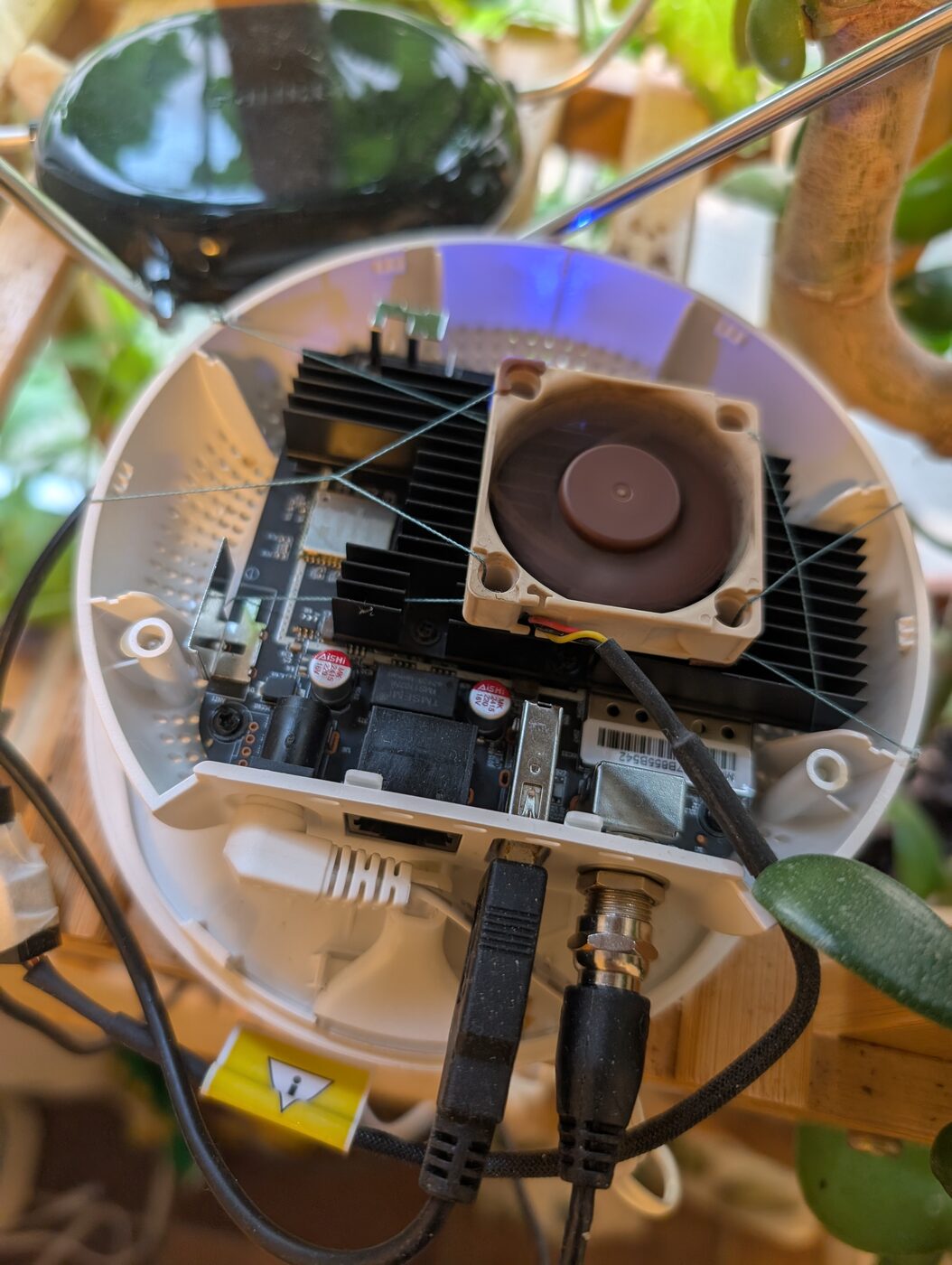
The result has been much better. It has been a month, the crashes have stopped almost entirely, and the box now survives a broadcast without disappearing from the network. That is not conclusive proof that heat was the only problem, but the correlation is strong enough for me: the failures were thermal, the device had no active cooling, and adding some fixed it.
What I’d do differently
If I were starting over and could run a cable, I would buy the HDHomeRun. The Tablo’s software has been the source of most of my complaints, and the enthusiast consensus is not wrong. But the WiFi requirement was real, and the tradeoff was reasonable: a buggier box in the right place beats a better box in the wrong one.